Wednesday, March 10, 2010

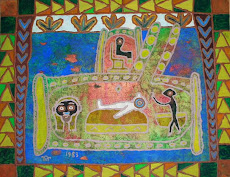
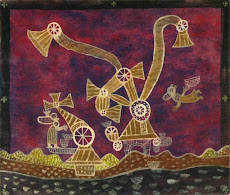
THE SHIP OF RAN/ collage art featuring the mermaid goddess Ran from Norse mythology


                                      The Voyage of Ran
                                      2002
                                      by Eric Whollem
                                      Ink and paper collage
                                      Collection of the artist
                                                       Copyright by the artist.

Ran and Aegir

Ran and Aegir live in a hall at the bottom of the sea.
The Norse say that the souls of sailors who drown
at sea are caught in the net of Ran. Aegir is a sea
giant.

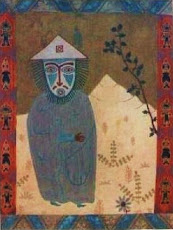
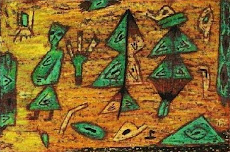
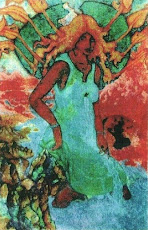
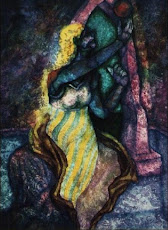
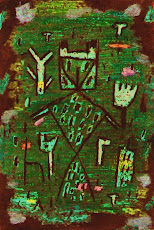
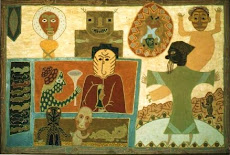
THE KNIGHT AND THE LADY OF WATERS/ a mixed media visionary painting


                                       The Knight and the Lady of Waters
                                       1987
                                       by Eric Whollem
                                       mixed media on  paper
                                       Collection of Pete Rose
                                       9 x 6"
                                        Copyright by the artist.

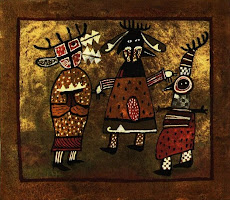
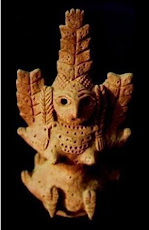
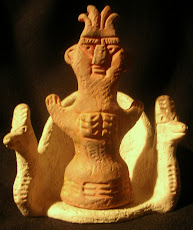
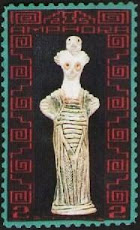
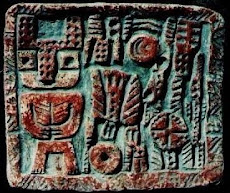
DEVI/ a devotional ceramic Goddess sculpture


Devi
2007
by Eric Whollem
ceramic sculpture
oxides on white clay
Collection of the artist.
6 7/8"
 Photo copyright by the artist.

The Prayers of Devi

Devi means "Goddess" in Sanskrit. Both Buddhists
and Hindus use this term. Deva means "God." This
latter term was popularized a few years back at
Findhorn in Scotland, when it was applied to fairies.
Thus today one often hears references to Devas of
this or that plant.

Saturday, March 6, 2010

A MAP TO SHAMBHALA/ The Way to Kalapa and the Lake of Shambhala Nor/ Shangri La and Shambhala/ Peach Blossom River/ Crossing the White Waters/ Mandala of the Four Rivers/ Altai Mysticism/ The Legend of Kalki/ Roseapple Island: a digression on Jambudvipa/ The Egyptian Tuat/ Tara Rising From the Waters/ The Nagas/ Pancha Raksha


               Tara Rising From the Mysterious Waters of the Lake of the North
                   or
               A MAP TO SHAMBHALA
               2010
               by Eric Whollem
                  Copyright by the artist

The Way to Kalapa
& The Lake of Shambhala Nor

Mystics of Tibet, Mongolia, Russia, India and Central Asia
have long searched for Shambhala. It is said to be a mystic
realm hidden from the eyes of men. Some say it can only be
reached after intense purification and meditation.

 
The Bon Po shamans, who lived in Tibet long before the
Buddhists, spoke of the land of Ol mo lung ring. They
visualized it as a square mandala with Kalapa, the central
city in the center. A nine-storied palace stood in the island
at the hub. This land later became known as Shambhala.

In the Kalachakra system of Tibetan Buddhism, Kalapa
is said to exist on an eight petalled lotus isle surrounded
by mountains. Edwin Bernbaum, who wrote A Way to 
Shambhala, relates that the lotus isle of Kalapa is set in
river water.

In some accounts the hidden city of Sadarsana at the top
of Mt. Meru (or Kailas) is identical with Kalapa.

The Kirghiz people also speak of the hidden city of Janaidar
which sits on the peak of Mustagh Ata. A white camel is
found near a lake at the top of this mountain. The Kirghiz
are an Altai people who live deep in Central Asia.

Other Tibetan views place Shambhala in the far north,
perhaps in the arctic. Uttarakuru means the land of the
far north. It is spoken of as another possible location of
the realm of Shambhala.


Uttarakuru
2010
by Eric Whollem
COPYRIGHT BY THE ARTIST


In the fairy lore of Persia it is said that the Peris, or fairies,
live in a place to the north called The Desert Island. This
legend parallels the stories of the island home of Kalapa,
Shambhala's capital city.


Shangri La and Shambhala

The novel, Lost Horizon, takes the Shambhala legend and
gives us the famous name of Shangri La. There is no doubt
that the author was somewhat familiar with Tibetan accounts
of Shambhala.

In the early 20th century Charles W. Leadbeater authored
books for the Theosophical Society called, The Hidden
Side of Things and The Masters. In these texts he describes
the Ascended Masters' retreats in hidden places in Tibet. He
describes archives of all human knowledge stored away in
secret libraries. This may have been the source of the Shangri
La story.

Peach Blossom River

The Chinese mystics, who long saw the mountains to the
west as the paradise of Peach Blossom River, called
Shambhala the Continent of Treasures. There is a famous
story of how Lao Tzu, weary with age, decided to leave
the earthly plane. He mounted the back of a water buffalo
and attempted to disappear into the Kun Lun Mountains.
A gate keeper would not let him through until he revealed
his wisdom. The result is the text of the Tao Te Ching.
Lao Tzu's journey was to the palace of Hsi Wang Mu,
at the headwaters of the Yellow River.

Peaches are the most sacred fruit of the Chinese. The
ancient Taoist masters used peach wood wands to draw
magic oracular shamanic diagrams in sand.


Crossing the White Water

The Ch'u T'zu poems of the third century B.C. describe
Li Sao's journey to fairyland, which is delineated as the
"ocean of the west." The west of China is desert. This
imagery could be a mystical view of an etheric ocean, as
the Gobi Desert is bereft of water. The ocean of the west
appears in Chinese folklore as the destiny of the spirits of
the dead. Could they be describing a version of the
Shambhala legend--with Shambhala as a sort of fairylike
heavenworld?

Li Sao crosses the White Water to reach fairyland. The
White Water is one of four rivers that flow from the Chinese
mandala of Kun Lun. The Yellow River along with the white,
black and red waters form this mandala.


Mandala of the Four Rivers

Lake Manasowar, near Kailas in Tibet, also has four rivers
that flow from it. Also Viking lore speaks of four rivers of
milk that flow from the udder of the mystic cow.

Thus the Four Rivers that flow from the Palace of Hsi Wang
Mu are mirrored in legends spread across Europe and Asia.


Altai Mysticism

Russian mystics bear tales of a lost paradise
which they said lies in The White Waters, or Belovodie.
They said that a portal to Shambhala exists near Mt.
Belukha in the Altai Mountains. Other stories say there
is a portal at Jugili Mountain near the Volga. Yet other
tales are about subterranean accesses somewhere on
the backside of the Urals.

Frequently sacred mountainous places are said in the
folklore of the people who honor them to have mystic
access through secret caves. Mt. Shasta in Northern
California is such a sacred mountain.*

*I got a lot of this data on Russian mysticism from a website
called Shalagram.Ru established by the Noosphere
Research Insitute. This site gives a very interesting
account of cosmic cartography, interpreting Shambhala
in the light of Celtic, Hopi, and other mystic lore. (Chapter
6 is recommended reading.)


The Legend of Kalki

The Kalachakra traditions of Vajrayana Buddhism
relate that at the end of times Kalki, a great hero, shall
arise as King of Shambhala and eliminate evil from the
world. Kalki would come on horseback to serve as the
savior of Buddhists.


Kalki
2010
by Eric Whollem
COPYRIGHT BY THE ARTIST


In the scriptures of India, Kalki is referred to as the
tenth incarnation of Vishnu, an incarnation to come.
The Kalki Purana speaks of his exploits in detail.

Tarthang Tulku's book, Mother of Knowledge, the
Enlightenment of Ye-shes m'Tsorgyal, bears a very
interesting bit of scriptural prophecy concerning the
future of Tibet. The account there parallels what we
have said concerning Kalki, the King of Shambhala.
A description ensues of the return of Buddhism after
Tibet is overrun with destroyers of the faith.

Ye-shes m'Tsorgyal or Jnanasagara (Sea Wisdom)
is the foremost female author of Tibetan wisdom
teachings.


Roseapple Island
A DIGRESSION ON JAMBUDVIPA

India has long been called the continent of Jambudvipa,
or The Roseapple Island. India is thus a part of the
apple island legends of the world. The Greek Hesperides
are one such group of apple islands. The Hawaiian
Islands are another group of apple islands. The Garden
of Eden with it's apples may relate to these legends.

Apples are ancient symbols of the human soul. In
Celtic legend apple boughs are carried on the sea
chariot of Mananaan McLer, the sea god. And the
curious animal, the Nidhog, a sea pig, is said to be
the consumer of souls...in the form of apples.

The Hebrides off the coast of Scotland are named
after the Greek Hesperides and thus also must be
included among the apple isles.

The most famous apple island of all is Avalon, the
mystic isle of King Arthur. Arthur's name stems from
Ausar, the Egyptian God of the Great Green Sea,
better known as Osiris.

The apple island legends may stem from an
archtypical legend from Heliopolis in Egypt, the
story of the land of swallows. The birds on this
island were said to be the souls of mankind.


The Egyptian Tuat
A COMPARISON TO  THE MANDALA OF SHAMBHALA

The Tuat was the name given to the place of the
Blessed Fields of the Dead, Sekhet-Aanru. This
was a field of reeds in the utmost northern
constellation.

It was encircled by river water. This was the mystic
Nile of the beyond. The hieroglyph for the Tuat is
rectilinear, which recalls the square mandala of
Ol mo lung ring, the prebuddhistic Shambhala of
Tibet.

The constellation of the north pole was a great fish
to the mind of the ancient Egyptians. The four
guardians of Horus stand at it's four corners. In
India the constellation of the north is Sisumara, the
porpoise.

The Hindu Paradise of Uttarakuru and the White
Waters of Belovodie recall the Tuat. A number of
Tibetan practitioners have identified the north pole
as the location of Shambhala, the crown chakra of
the earth.


Tara Rising From the Waters
FROM THE MAP TO SHAMBHALA

Tara is described in the Lankavatara Sutra and
also The Legends of the Mahasiddhas as dwelling
in the sea.

She rose from the palace of the King of Sea Serpents
to give the sage Nagarjuna the Prajnaparamita teachings.

Dakinis, or female demigods, are also frequently
described as living in lakes.


The Nagas


Tara and the Dakinis thus could be said to belong to
the categories of Naiads and Oceanids from European
legend. Like the Apsaras of the Rig Veda, or Benten,
the Daughter of the Sea King, from Japan, they are not
depicted with the fish tails of mermaids, but stand on
two feet. The Greeks also gave their aquatic demigods
feet. However the Nagas and Naginis of Tibet and India
bear closer ressemblance to our popular notions of the
mermaids and mermen--having the upper torsos of
humans but the tails of cobras--symbols of Kundalini.


Pancha Raksha
A YIDAM OR TUTELARY GUARDIAN

Not far from Mt. Kailas (Meru) is a Tibetan monastery
with a depiction of Pancha Raksha, a Tibetan Nagini.*


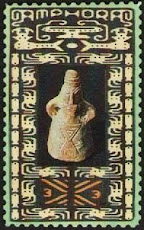
This video presents my stamps from Shambhala Nor:


____________________________________
*She appears on the stamps of Shambhala Nor.

Readers interested in my posts on the subject of Shamanism may want to see this link:

My posts on Mythology may be found here:

For my posts on Mythographic Art see:
http://artblogericwhollem.blogspot.com/search/label/mythographic%20art


SHAMBHALA NOR POST
2000
by Eric Whollem
COPYRIGHT BY THE ARTIST

For my gallery of FAUX POSTAGE STAMPS from Shambhala Nor see:


A LETTER FROM SHAMBHALA
Eric Whollem
2010
copyright by the artist

View more of my fantasy letters from Shambhala on the link below:
http://artblogericwhollem.blogspot.com/2015/10/letters-from-shambhala-tibetan-fantasy.html


*
Artist stamps, artistamps, cinderella stamps, fantasy stamps, faux postage, mail art, micronation stamps by Eric Whollem; spirituality, meditation, Buddhist American Folk Art, metaphysical art, mythology, shamanism.

*

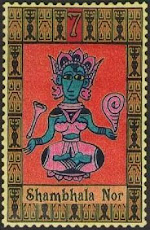
BLUE TARA/ a faux postage stamp from Shambhala Nor: a meditational divinity from the Vajrayana tradtion, rendered in a Buddhist American Folk Art style

Shambhala Nor Postal Service


"Blue Tara"
2000
by Eric Whollem
Edition of 100, plus ten artist proofs
58 x 88 mm.
Copyright by the artist.


Ekajati, the Destroyer of Anger
The Role of Blue Tara

Blue Tara is varyingly depicted. Sometimes she appears in
a fierce image. This is because she is a protector. She
removes all anger from those devoted to her.

Friday, March 5, 2010

DAKINIS OF THE RED CLOUDS/ faux postage stamps from Shambhala Nor, featuring meditational deities based on Vajrayana Buddhism

Shambhala Nor Postal Services


"Dakinis of the Red Clouds"
2000
by Eric Whollem
Editions of 100, plus ten artist's proofs
58 x 88 mm.
Copyright by the artist.

from
Shambhala Nor
the lost city of the lake of the north

BELOW IS A VIDEO OF STAMPS
FROM SHAMBHALA NOR


ERIC WHOLLEM                                          


*
Metaphysical art; meditational deities; Dakinis; Buddhist Amerian Folk Art; artist stamps,
artistamps, cinderella stamps, fantasy stamps, faux postage, mail art, micronation stamps by Eric Whollem

THE CAPTAINS OF KALKI/ a cinderella stamp featuring the legend of a Buddhist savior

Shambhala Nor Postal Service


"The Captains of Kalki"
2000
by Eric Whollem
Edition of 100, plus ten artist's proofs.
88 x 58 mm.
Copyright by the artist.


The Legend of Kalki

Tibetan legend has it that in the last days a leader
called Kalki shall rise to restore the lands of the
Buddhists. He is usually depicted on horseback.
In the Kalachakra tradtions it is related that no
less than twenty five kings of Shambhala have
been named Kalki.


SHAMBHALA NOR STAMPS
by Eric Whollem
                                                                                                      
                                                                                                
Kalki is also featured in Hindu lore as the last
incarnation of Vishnu. The Kalki Purana relates
details of his exploits to be.


Faux Postage From Shambhala Nor

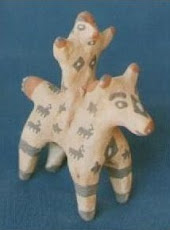
These fantasy stamps from Shambhala Nor show
two riders on distinctly small Himalayan ponies.
These actually were originally ceramic sculptures
that I created in the 1990's.

The back ground of this stamp was designed on
an antique 1980's word processor, using the
Print Master program available in those days.
I printed on colored paper stock then reassembled
the design with collage technique.

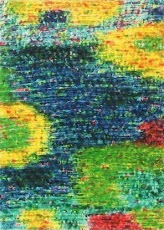
This stamp has a nice feeling of spatial depth. The
blue center receeds, giving the viewer the feel that
he is looking into a pool of water. These are the
waters of Shambhala Nor, the mystic city of the
Lake of the North. Nor means lake in Mongolian.

_______________________

See my posts about SHAMBHALA:

*
Artist stamps, artistamps, cinderella stamps, fantasy stamps, faux postage, mail art, micronation stamps; Vajrayana Buddhism

THE DAKINIS OF THE GOLDEN FISH/ a set of cinderella stamps from Shambhala Nor, the mystic city of the Lake of the North; with comments on the location of the realm of Shambhala

Shambhala Nor Postal Service


"The Dakinis of the Golden Fish"
2000
by Eric Whollem
a set of two stamps
Editions of 100, plus ten artist's proofs
60 x 89 mm.
Copyright by the artist.


The Two Golden Fish of Enlightenment

Among the Eight Auspicious Symbols of Northern Buddhism are
the two golden fish of enlightenment. These are depicted as two
golden carp. These two fishes also appear in ancient Egypt as the
Ant and Abtu fishes.

PANCHA RAKSHA/ a cinderella stamp from Shambhala Nor featuring a yidam, or protector, from Vajrayana Buddhism; a nagini, or aquatic demigoddess

Shambhala Nor Postal Service


"Pancha Raksha"
2000
by Eric Whollem
Edition of 100, plus ten artist's proofs
60 x 89 mm.
Copyright by the artist.


The Yidams

In the Tayul Monastery by the town of Keyong in
Tibet is a mural that depicts Pancha Raksha. She is a
Nagini, or waterserpent demigoddess. The Nagas
also appear in the lore of India. The stone sculptures
at Mahamallapuram are some of the most famous
depictions of the Nagas and Naginis. The Gopis
who sport with Krishna are also seen depicted with
waterserpent tails.

DAKINIS/ cinderella stamps from Shambhala Nor featuring meditational divinities from Vajrayana Buddhism

Shambhala Nor Postal Service


"Levitating Dakinis"
2000
by Eric Whollem
a set of two stamps
Editions of 100, plus ten artist's proofs
60 x 89 mm.
Copyright by the artist.


The Dakinis of the Lake

These stamps show two views of Shambhala Nor, the mystic
lake of the north. This lake is the home of the Dakinis of
Shambhala.*

Nagarjuna Receiving the Prajanaparamita Teachings From Tara Rising From the Waters/ CINDERELLA STAMPS FROM SHAMBHALA NOR/ buddhist american folk art from the twenty first century

 Shambhala Nor Postal Services


"Nagarjuna and Tara"
2000
by Eric Whollem
Edition of 100, plus ten artist's proofs
58 x 88 mm.
Copyright by the artist.

Readers interested in my artist stamps from Shambhala Nor should view this link:

To access my posts on Meditation check out this link:

My posts on Spirituality can be viewed here:

My articles on Metaphysical Art are on this link:

To see my Cinderella Stamps view this link:


*
Artist stamps, artistamps, cinderella stamps, fantasy stamps, mail art, micronation stamps; metaphysical art; goddess art; mermaids;  Buddhist American Folk Art

Wednesday, March 3, 2010

GREEN TARA/ A History of Tibetan Postage Stamps/ THE STORY OF THE STAMPS OF TANNU TUVA/ Mongolian Postal Issues/ Featuring a cinderella stamp from Shambhala Nor, the mystic city of the Lake of the North

Shambhala Nor Postal Services


"Green Tara"
2000
by Eric Whollem
edition of 100, plus ten artist's proofs
58 x 88mm.
Copyright by the artist.


THE LEGENDS OF THE MAHASIDDHAS
Tara and the Sage Nagarjuna

Prajnaparamita, the Goddess Wisdom, was preserved for seven hundred years
in the preserves of Makara, the King of Sea Serpents. Tara at last rose from the
sea with the teachings of Prajnaparamita and gave these to Nagarjuna. This was
the beginning of Mahayana Buddhism.

SHAMBHALA NOR/cinderella stamps featuring the chod rite of Vajrayana Buddhism

Shambhala Nor Postal Services


"Chod"
2000
a set of two stamps
by Eric Whollem

from
Shambhala Nor
the lost city of the lake of the north

edtions of 100, plus ten artist's proofs each
60  x 89 mm.
Copyright by the artist.


These stamps could be called by a variety of names, including: artist stamps,
artistamps,  cinderella stamps, fantasy stamps,  faux postage, mail art, or 
micronation stamps.

Shambhala Nor could be interpreted as a "micronation" from my own imagination. 
William Blake once said that "Nature is the Imagination." In this he was paralleling the
Buddhist idea that everything we experience is a projection of Maya.

Featured are meditation images based on Himalayan Buddhist folk art as rendered
by myself--using ink on  paper and collage, with border designs created on an antique
1980's word processor.

Tuesday, March 2, 2010

THE FIRST LEAF OF SPRING/ figurative expressionism


                                 The First Leaf of Spring
                                 1986
                                 by Eric Whollem
                                 gouache and wax resist on paper
                                 Collection of the artist.
                                 8.5" x 11"
                                 Copyright by the artist.

The Naiad

Here the Naiad sits by the pool, her cup of wisdom not far off.
It is springtime and the oak has sent forth it's first new leaf.
The Naiad is the oracle of the pool. She speaks only in fresh,
green verse.

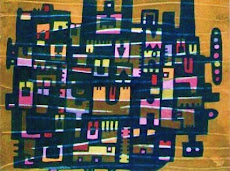
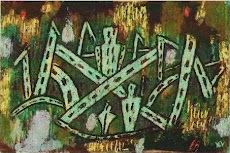
ALTRUISM/ With An Analysis of Literary Meanings in Art, Based on Kandinsky's Pioneering Abstract Art Theories/ pictographic calligraphy


               Altruism
               1985
               by Eric Whollem
               India ink, watercolor and wax resist on paper
              Collection of the artist.
              9" x 6"
                  Copyright by the artist.

Thought Forms

Leadbeater and Besant wrote a highly influential book called
Thought Forms, still in  print from the Theosophical
Publishing House. These writers worked with a group of
sensitives and determined that the emotions and thoughts of
the human mind appear as distinct shapes with defining colors.
Abstract images appeared as illustrations in this book.

Sunday, February 28, 2010

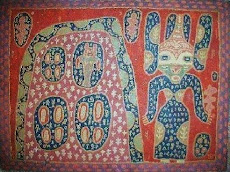
LITTLE SPIRIT PEOPLE/ kakinim from the lore of the maidu indians/ AN ABSTRACT WORK OF ART BASED ON A STUDY OF PREHISTORIC CALIFORNIA ROCK ART: PICTOGRAPHS AND PETROGLYPHS


    Little Spirit People
    1984
    by Eric Whollem
    watercolor and wax resist on paper
    Collection of the artist.
    9" x 6"
         Copyright by the artist.

Kakinimkodom

The Maidu Indians of Northern California divide their heavenworlds
into three zones. Kakinimkodom, the country of the spirits, is the
highest level.

In this image I depict images of Aki, the duck, and the waters of
Supi Poboku. Supi Poboku is the Middle Fork of the Feather River.
Aki is the highest spirit in the Hesi Dance Cycle of the Kuksu Secret
Society.

This imagre is from my own imagination, but derives stylistically from
the pictographic rock art of so-called prehistoric California.

See my posts about the Maidu Indians on this link:

*
Abstract art, mixed media painting, pictographs, rock art, Maidu Indian lore.
FIGURATIVE ABSTRACTION.

*

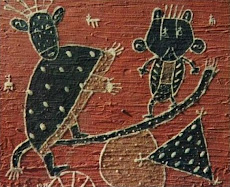
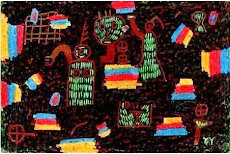
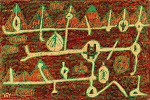
PICTOGRAPHIC EXPLICATIONS/ a figurative abstraction


   Pictographic Explications
   1985
   by EricWhollem
   gouache and wax resist on paper
   Collection of the artist.
   9" x 6"
       Copyright by the artist.


FLICKERING SPIRIT DARK/ a contemporary vision of california indian rock art


     Flickering Spirit Dark
    1984
    by Eric Whollem
    watercolor and wax resist on paper
    Collection of the artist.
    9" x 6"
        Copyright by the artist.


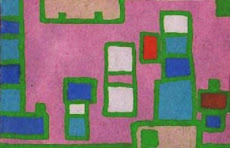
POLARITY CALIFORNIA/ watercolor and wax resist on paper/ FIGURATIVE ABSTRACTION


                                                  Polarity California
                                                  1984
                                                  by Eric Whollem
                                                  watercolor and wax resist on paper
                                                  Collection of the artist.
                                                  6" x 9"
                                                       Copyright by the artist.