Friday, March 11, 2011

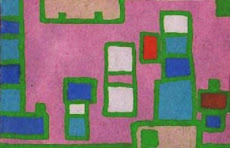
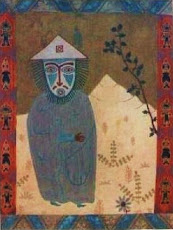
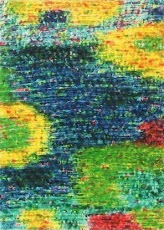
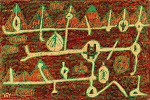
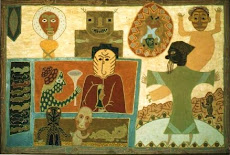
FIGURATIVE ABSTRACTION/ 'Watermoon' by Eric Whollem, 1986/ 'Notes on the West Coast School of Figurative Expressionism'/ My interactions with Elmer Bischoff, as my art instructor/ MIXED MEDIA ON PAPER


Watermoon
1986
by Eric Whollem
mixed media on paper
Collection of the artist
20 7/8" x 14 7/8"
COPYRIGHT BY THE ARTIST

Notes on the West Coast School of Figurative Expressionism

I studied art formally at U.C. Berkeley in the late 1960's and early
1970's. The late Elmer Bischoff, now relatively well known, was my
life drawing instructor. I often would take my paintings to him for
his comments. He was a very easy going man with a good sense of
humor. He often would draw very exaggerated figurative images
to amuse his classes.

U.C. Berkeley, the San Francisco Art Institute, and the California
College of Arts and Crafts in Oakland at that time were known as
the bastions of the West Coast School of Figurative Abstraction.

The figureheads of this movement were artists such as Diebenkorn
and Hans Hoffman, David Park, and, of course, Elmer Bischoff.

Although my works over the years generally bear little ressemblance
to the established masters of this tradition, my paintings have very
often been figurative abstractions.

The work, 'Watermoon,' seen here has certain affintities to Abstract
Expressionism, but is laced with pictographic forms based upon my
studies of Native American petroglyphs.


                                 Figurative Abstractions Video.

_______________

Readers interested in reading more about the West Coast Figurative Expressionists should see:

See more about ELMER BISCHOFF here:


Figurative Expressionism Video                              

See more of my FIGURATIVE ABSTRACTIONS on this link:

See my posts on EXPRESSIONISM:

*

Tuesday, March 8, 2011

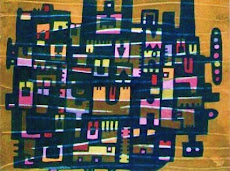
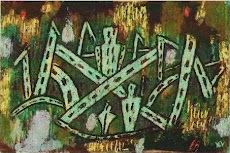
CONTEMPORARY ART/ 'Fugue on Manganese' by Eric Whollem/ A Pictographic Abstraction/ Mixed media on paper, incorporating earth pigments in polyvinyl resin


Fugue on Manganese
1979
by Eric Whollem
watercolor, gouache, earth pigments
and polyvinyl resin on paper
17 7/8" x 14"
Collection of the artist
COPYRIGHT BY THE ARTIST

An Abstraction From the 1970's

This is an early work of mine. It harmonizes geometric rhythms with
organic shapes. Bach's musical work, 'Die Kunst der Fugue,' has long
been one of my favorite classical pieces. I used to paint listening to
Bach, Hayden and Mozart frequently in the 1970's.

I also began listening to international ethnic music. Aboriginal
Australian djeridu, Zen sakahuchi, and Central Asian melodies all
contributed to my mood.

_________________

See more of my EARLY WORKS on this link:

Readers may also wish to peruse my posts of ABSTRACT ART:

*

Sunday, March 6, 2011

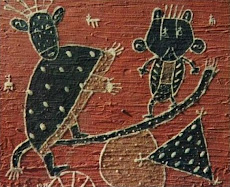
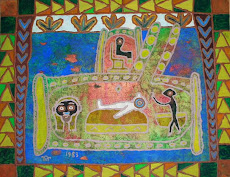
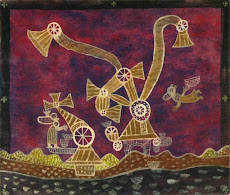
FIGURATIVE ABSTRACTION/ 'Village of the Coyote' by Eric Whollem, 1985/ A modern art depiction of traditional Native American Indian lore~Coyote Legends/ Notes on Concow Maidu Lore on Henokano, the Trickster Coyote/ CONTEMPORARY ABSTRACT ART


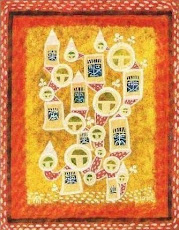
Village of the Coyote
1985
by Eric Whollem
mixed media on paper
15" x 21 1/4"
COPYRIGHT BY THE ARTIST

CLICK ON IMAGE TO ENLARGE

Henokano

Coyote is called Henokano by the Concow Maidu Indians of
Butte County, California. Coyote, of course, is featured in the
legends of numerous Native American people.

According to the Maidu, Henokano was one of three archetypical
beings who floated on a raft in a great ocean at the beginning of
time. Turtle, or Ultrama, was there. Also Wonomi, or Earth
Initiate.


SHAMANISM AND COYOTE

Coyote is conceived of as a trickster. The Maidu stories tell us
that originally the stars were placed in an attractive pattern in
the sky~but Henokano scattered them in a disorderly manner.

Today at Little Bald Rock in Butte County, one can see Coyote's
wife. She is a large triangular shaped  granite boulder.

Coyote is also remembered in stone by the Concow Maidu. He
appears on Table Mountain above Oroville, California, laying next
to Lizard. Not far off is a large stone that is Wonomi, the Earth Initiate.
These stones are basaltic lava formations.

In some Native American views, the trickster energy is parcel of
the mindset of a shaman. A shaman is often a clown, creating
mock situations that ultimately lead to healing through humor.

___________

Readers may wish to view my posts that deal with NATIVE AMERICAN influences in my art on these links:

Those specifically seeking posts on the CONCOW MAIDU INDIANS should see:

Others may want to see more of my ABSTRACT ART:

See more about MEDICINE ANIMALS here:

*


Friday, March 4, 2011

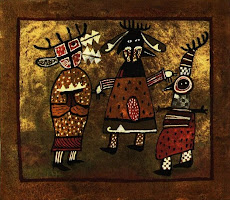
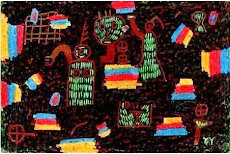
FIGURATIVE ABSTRACTION/ 'Intuitive Beings' by Eric Whollem/ A mixed media pictographic abstraction on paper


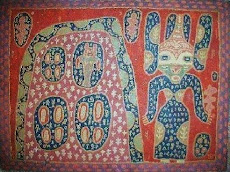
Intuitive Beings
1987
by Eric Whollem
gouache, parafin and metallic paint on paper
15 3/4" x 11 3/4"
Collection of the artist
COPYRIGHT BY THE ARTIST

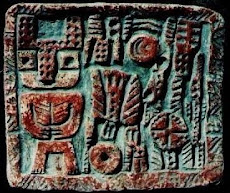
A Pictographic Abstraction

The above painting incorporates elements from California
prehistoric rock art~specifically the circular forms with
dashes that run around the periphery. Such designs are
common in the rock art of the Chumash Indians of the
Santa Barbara area of Southern California.

One might observe that I have followed suit with the use
of form found in Abstract Expressionism, a movement
popular (that is to say among afficionados of abstract art)
in the late 1940's and 1950's.


Zen and Taoist Influences

A number of the Abstract Expressionists were influenced
by Zen calligraphy. Although this work in particular does
not bear any affinity to Zen art, I have studied the works
of Suzuki and other Zen masters. I always was impressed
by Huang Po and other Chinese Chan precursors of the
Japanese Zen. In Korea Zen is called Son Buddhism.

Chinese philosophy was a hobby of mine when I was in
college. I especially was influenced by Chuang Tzu, the
hermit nature philosopher. His teachings no doubt were
important catalysts to my immersion in nature over the
years. I have spent much of my life as a hermit in the
Sierra Nevada Mountains and foothills. . . in places such
as Palermo, Feather Falls, Swedes' Flat, and Concow.

This painting was painted in Swedes' Flat, an area in the
oak and gray pine studded foothills of Butte County. I lived
at an elevation of 1500 feet, just above the valley fog. I was
graced with views of hills and trees rising up out of an
ocean of fog in the winter. . . something archetypically
oriental.

________________

Readers interested in my FIGURATIVE ABSTRACTIONS should see this link:

*

Tuesday, March 1, 2011

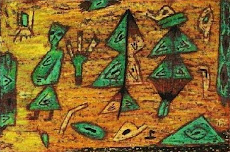
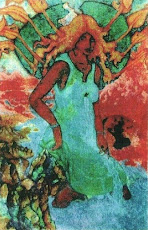
CONTEMPORARY PAINTING/ 'The Spirit of Autumn' by Eric Whollem/ A figurative abstraction/ Mixed media on paper/ ABSTRACT ART


The Spirit of Autumn
2003
by Eric Whollem
mixed media on paper
6 7/8" x 9 7/8"
COPYRIGHT BY THE ARTIST

CLICK ON IMAGE TO ENLARGE

An Allegory of Nature

My art over the years has drawn upon innumerable sources, but
the work above takes most of it's influence from the storehouse
of Imagination.

________________

Readers interested in my FIGURATIVE ABSTRACTIONS should view this link:


Figurative abstraction video.                  


Also of interest may be my GEOMETRIC ABSTRACTIONS:

*
Friday, February 25, 2011

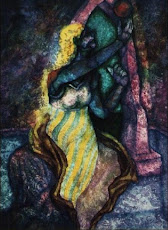
FIGURATIVE PICTOGRAPHIC ABSTRACTION/ 'Light of the Mother and Son' by Eric Whollem, 1984/ Concow Maidu Influences in Modern Art/ CONTEMPORARY ABSTRACT ART/ Mixed media on paper/ With comments on the art of Harry Fonseca, Nisenan Maidu Artist


Light of the Mother and Son
1984
by Eric Whollem
mixed media on paper
9" x 6"
COPYRIGHT BY THE ARTIST

Concow Maidu Influences in Modern Art

I lived as close neighbors to Concow Maidu Indians from Northern
California off and on for 35 years. It is no surprise that their culture
greatly influenced the style and themes of much of my art.

The painting above is filled with pictographic icons that derive from
California Native American rock art: pictographs and petroglyphs.
The Maidu have a few traditional sites where such imagery appears.

I was shown some Mountain Maidu petroglyphs near Susanville by
Adrian Smith, former head of the Butte County Tribal Council. Many of
these were damaged by vandalism. I found a stone with concentric
engravings near Milsap Bar along the Middle Fork of the Feather River.
This stone was near what appeared to be a large and perfect fishing
hole. Maidu petroglyphs are also found on Table Mountain above
Oroville, but are extremely hard to locate. But the images are recorded
in Heizer's book on California rock art.


              CONCOW MAIDU Video by E. Whollem


THE SACREDNESS OF THE MOTHER

This painting deals with the Mother concept, the title being, 'Light
of the Mother and Son.'

There is much traditional lore that deals with the sacredness of the
Mother Principle. For example, just beyond Little Bald Rock in
Butte County, is a large granite dome that is called Oost Ho, which
means literally 'Belly Rock.' This dome is conceived as the pregnant
form of a great Goddess or female creative spirit.


EARTH PAINTS

In 1973 I began to make paints from raw materials. The Maidu
made earth paints, as well as  paints from pollen and acorn meal
in the old days. They are known to have traded a green earth
pigment to tribes across the Sacramento Valley in the Coast Range.
Earth  paints have been traditionally used as body paints in dance.


            EARTH PAINTINGS Video by E. Whollem


PICTOGRAPHS AND PETROGLYPHS IN MODERN MAIDU ART

Contemporary Maidu artists such as the Harry Fonseca have
delved into modern abstract art with interpretations of pictographic
iconography. See the links below to find a very interesting interview
with Fonseca. Fonseca was of Nisenan, or Southern Maidu, ancestry.
My contacts among the Maidu have been with the Maidu of Butte
County~the Concow Maidu. See my links below to read more about
my friends and associates~mostly from the Feather Falls and Berry
Creek peoples. The Concow Maidu are referred to as the West People.

Fonseca's pictographic work appears to be imbued with iconography
akin to Great Basin and Southwest Native American rock art.  The
styles of California rock art are generally less figurative and more
abstract--with notable exceptions. . .such as the prevalent big horn
sheep images found in Eastern Sierra rock art. Fonseca, long an
inhabitant of the Southwest, nevertheless was greatly influenced by
the Eastern Sierra petroglyphs near Owens Lake in California. Many
images of the big horn sheep are found in that area. Owens Lake is
located south of traditional Maidu territory.

 I have also delved into the arts of Utah and the Southwest, but I have
tried to add a Californian flavor to my designs. I was originally
inspired as an art student by the Navajo sandpaintings of David
Villasenor.

My own pictographic designs have incorporated elements from
such California Native American groups as the Chumash and the
Modoc, and other Sierra Nevada rock art beyond the the localities
where the various Maidu peoples have their native territory. The
Sacramento Valley, Sierra Foothills, and the northern Sierra Nevada
mountains are the areas of the Maidu. In these areas the rock art is
highly abstract. Heizer's ethnographic transcriptions of prehistoric
California rock art has long been a major guide to my studies.


            PICTOGRAPHIC ART Video by E. Whollem


Pictographic imagery appears in Maidu basketry however and has some
figurative elements such as the wuh-wuh form, which is the triangle
which represents Koi, the sacred Goose, the bird of Heaven.

Artists must rely upon imagination to recreate or create mythological
images. . . especially in areas where the traditional vocabulary of
visual icons is sparse. This has been the case with the Nisenan artist,
Fonseca, as well as myself, an initiate of the esoteric lore of the Concow
Maidu.

I created a video called 'The Ghost Oak' with Russ Dunn as well as
Adrian Smith of the Butte County Tribal Council. This animation
told the story of the destruction of the giant sacred mother oak tree
that used to stand in Durham, California, just south of Chico. It was
said that seven kinds of acorns grew on that tree~now cut down for
firewood.
________________

See more of my posts that deal with the MAIDU INDIANS on this link:
http://artblogericwhollem.blogspot.com/search/label/maidu%20indians

See a very informative interview with HARRY FONSECA on this link:
http://www.britesites,com/native_artist_interviews/hfonseca.htm
If this link is broken, try a Google Search for the site.

Also check out HARRY FONSECA on:
http://www.harryfonseca.com

See more of my FIGURATIVE ABSTRACTIONS here:

Readers interested in my approaches to EARTH PAINTS should see these posts:

*
Wednesday, February 23, 2011

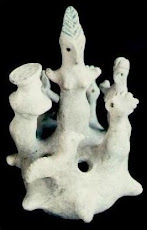
FIGURATIVE ABSTRACTION/ 'The Beetle' by Eric Whollem/ A pictographic abstraction based upon styles from human antiquity/ MODERN ART/ Mixed media on paper


The Beetle
1978
by Eric Whollem
mixed media on paper
4 3/16" x 6 1/8"
COPYRIGHT BY THE ARTIST

The Beetle

This work is styled mostly on Native American rock art,
which has long been one of my major influences. As one
will note by the date, 1978, this is one of my early works.

In 1973 I began a novel, entitled, 'Rainbeetle,' which
expressed my interests in folklore, mythology, etc. This
work is thus one of many beetle images that I have
created over the years.

__________________

Readers interested in my posts that deal with RAINBEETLE might want to see:

My complete archive of ABSTRACT ART can be found here:

*

CONTEMPORARY FIGURATIVE ABSTRACTION/ 'The Cosmic Piper' by Eric Whollem/ Mixed media on paper/ ABSTRACT FIGURE PAINTING/ Notes on the Akashas, Sabda, and sonic vibrations


The Cosmic Piper
1984
by Eric Whollem
mixed media on paper
4" x 6"
COPYRIGHT BY THE ARTIST

A Contemporary Figurative Abstraction

This work of mine from the 1980's depicts an allegorical
image of 'The Cosmic Piper.' This work is not based upon
any specific mythology, but is a universalized anthropomorphic
interpretation of sonic vibrations.

In Hindu thought, the Akashas, which are seven in number,
are etheric dimensions rooted in vibration. Sabda is sound.
Physical objects in this system are said to be manifestations
of vibrations of sound.

*

Monday, February 21, 2011

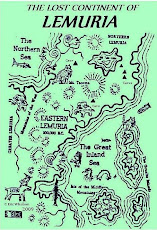
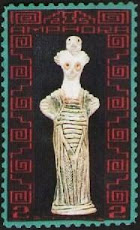
LEMURIAN FAUX POSTAGE STAMPS/ Views of Mt. Shasta/ Photo collage cinderella stamps based on photos taken from above Lake of the Heart/ Gummed and perforated fantasy stamps in limited editions/ SHASTA VISIONARY ARTIST STAMPS


View of Shasta
LEMURIA
2004
by Eric Whollem
edition of 100
85mm x 62mm
COPYRIGHT BY THE ARTIST


Faux Postage Stamps from the Lemurian Postal Administration

I have been creating fantasy stamps 'from' Lemuria for a
number of years now. These stamps from 2004 as seen
above are trial proofs and artist proofs for limited editions
of 100 stamps. These issues have been signed and numbered
on the obverse.

The borders of these stamps were designed on an antique
word processor Print Master Program. The reader will
observe the stylized geometric lemurs.

Those who might be unfamiliar with the genres of artistamps,
faux postage stamps, cinderella stamps, etc. should see:


View of Shasta
LEMURIA
2004
by Eric Whollem
edition of 100
85mm x 62mm
COPYRIGHT BY THE ARTIST


View of Shasta
LEMURIA
2004
by Eric Whollem
edition of 100
85mm x 62mm
COPYRIGHT BY THE ARTIST


View of Shasta
LEMURIA
2004
by Eric Whollem
edition of 100
85mm x 62mm
COPYRIGHT BY THE ARTIST

Lake of the Heart

Lake of the Heart is a diminutive lake that is found above
Castle Lake which is located about ten miles to the west
of Mt. Shasta City, California.

The photos for these stamps were 35mm. shots that I took
on the ridge high above Lake of the Heart.


View of Shasta
LEMURIA
2004
by Eric Whollem
edition of 100
85mm x 62mm
COPYRIGHT BY THE ARTIST


View of Shasta
LEMURIA
2004
by Eric Whollem
edition of 100
85mm x 62 mm
COPYRIGHT BY THE ARTIST


Video by Eric Whollem, 2011.

See more of my LEMURIAN STAMPS on this link:

Those interested in my posts that deal with MT. SHASTA should view these links:

Readers may also be interested in my stamps from ATLANTIS:

Artist stamps, artistamps, cinderella stamps, fantasy stamps, faux postage, mail art, micronation stamps.

*

Thursday, February 17, 2011

THE DESCENT OF PERSEPHONE/ The Eleusinian Mysteries/ INITIATION/ Mermaid Artist Stamps by Eric Whollem/ A sheet of cinderella stamps from the micronation of Undinia/ FAUX POSTAGE STAMPS FROM THE UNDINIAN PHILATELIC EXPOSITION/ Provisional Postage Cyberstamps by Eric Whollem


The Descent of Persephone
UNDINIA
2010
by Eric Whollem
COPYRIGHT BY THE ARTIST

CLICK ON IMAGE TO ENLARGE

The Descent of Persephone

The Eleusinian Mysteries of ancient Greece have an allegorical
tale that tells the story of the initiation of Persephone.

Persephone descends into the Abyssos to cross the River Styx
where she encounters an image of Eros in the form of a flower.
Eros is one of the Initiators, or Hierophants of the Mysteries.
Apollo is the second Initiator.

Persephone legendarily mistakes the image of Eros for reality
and is condemned to rise each spring from her abode in Hades,
where she was designated as the bride of the God of the Dead

According to Barbara Vivino, Persephone was depicted as a
fishtailed mermaid by the Greek colonists of Calabria in
Southern Italy.

The Greek mermaids are of two orders: the Nereids, of the salt
sea and the Naiads of rivers and springs. It is in the Underworld,
exemplified by the River Styx, that salt water and fresh water
merge. Subterranean springs often are imbued with salts, albeit
salts of sulphur and other minerals.

The Abyssos or the Sea is said to be the abode of the dead.


The Descent of Persephone
UNDINIA
2010
by Eric Whollem
COPYRIGHT BY THE ARTIST

CLICK ON IMAGE TO ENLARGE

REBIRTH

In rites of initiation, death is seen as a symbol of rebirth.
Persephone's story is a story of rebirth. As the Narcissus '
flower she is reincarnated every spring.

 
The Descent of Persephone
UNDINIA
2010
by Eric Whollem
COPYRIGHT BY THE ARTIST

CLICK ON IMAGE TO ENLARGE

The Descent of Persephone
FAUX POSTAGE STAMPS
by Eric Whollem

 
The Descent of Persephone
UNDINIA
2010
by Eric Whollem
COPYRIGHT BY THE ARTIST

CLICK ON IMAGE TO ENLARGE

 
A CYBERSTAMP SOUVENIR SHEET EDITION
THE ROYAL POST OFFICE
AND WHARFSIDE TELEGRAPH
Undinia

 
The Descent of Persephone
UNDINIA
2010
by Eric Whollem
COPYRIGHT BY THE ARTIST

__________________

See more of my stamps from Undinia on this link:

 
A mermaid video/STAMPS OF DELPHYS.                   

See more of my posts on MYTHOLOGY on this link:

THE VIDEO BELOW PRESENTS A
MYTHOGRAPHIC
VIEW OF THE
ELEUSINIAN MYSTERIES, ETC.

PORTAL OF THE SEASKY by Eric Whollem                 
*
Artist stamps, artistamps, cinderella stamps, cyberstamps, fantasy stamps, faux postage, mail art,
micronation stamps; virtual stamps. Digital art. Mermaid art.

*

Monday, January 31, 2011

CERAMIC AMULETS/ Neoclassical Ceramic Sculpture by Eric Whollem/ CLAY PENDANTS/ Goddess Art/ Figurative Ceramic Sculpture


Erato
2006
by Eric Whollem
oxides on white earthenware clay
PHOTO COPYRIGHT BY THE ARTIST

CLICK ON IMAGE TO ENLARGE

The Muses

The nine Apollonian Muses included Erato, the
Muse of Erotic Poetry.

The ceramic sculpture depicted here is an amulet
rendering my own modern version of Erato in
profile. 


The Centaur
2006
by Eric Whollem
oxides on terracotta
PHOTO COPYRIGHT BY THE ARTIST

 CLICK ON IMAGE TO ENLARGE

The Centaurs

Greek mythology incorporated a variety of imaginary
beings, among which the Centaurs are well-known.

The amulet shown here depicts a Centaur's head with
a stylized helmet, featuring a rendition of a horse's mane.


Aurora
2006
by Eric Whollem
oxides on terracotta
PHOTO COPYRIGHT BY THE ARTIST

CLICK ON IMAGE TO ENLARGE

Attic Art Revisited

Attic Art was one of the early phases of ancient
Greek art. The figures on Attic vases often are
shown with highly stylized faces, which often
included oversized triangular noses.

This modern ceramic sculpture recapitulates the
Attic phase of art, which was always highly geometric.


Clio
2006
by Eric Whollem
oxides on white earthenware clay
PHOTO COPYRIGHT BY THE ARTIST

CLICK ON IMAGE TO ENLARGE

Clio

Clio was another of the Muses of Apollo.
She was the Muse of History.


The Griffin
2007
by Eric Whollem
oxides on white earthenware clay
PHOTO COPYRIGHT BY THE ARTIST

CLICK ON IMAGE TO ENLARGE

A Short History of the Griffin

The Griffin was a heraldic animal that originated in Crete.
The Griffin is part eagle and part lion.

The Griffin became popular in Central Asia much later. . .
in places such as Kazakhstan, Persia and Armenia.

It eventually entered into the symbolic language of heraldic
emblems and was utilized throughout Europe.

The image above is my own modern version of the Griffin,
designed as a pendant to be worn on a necklace.

_________________

Check out Wikipedia for more about GRIFFINS:

Those interested in the APPOLONIAN MUSES should see:

See my posts of CERAMIC AMULETS on this link:


Ceramic Sea Horse Pendants and Wallpieces.                      

My general posts of CERAMIC SCULPTURES can be accessed here:


Ceramic Sculpture Video.                                      


Some readers may want to see my posts on MYTHOLOGY:

Also of interest might be my posts on MYTHOGRAPHIC ART:

*