Tuesday, September 21, 2010

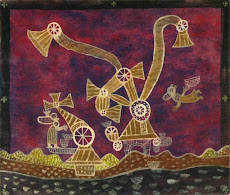
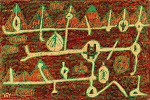
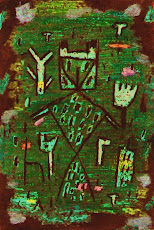
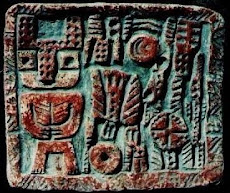
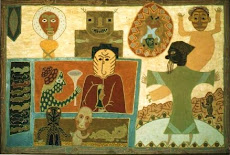
HAIKUTWOTOPEH: OLD MAN OF THE NORTH/ A Concow Maidu Legend/ FIGURATIVE ABSTRACTION/ The Story of How Gaming is Sacred Among the Maidu/ THE GRASS GAME/ A figurative pictographic abstraction by Eric Whollem/ A mixed media resist that interprets prehistoric Native American rock art in light of contemporary art


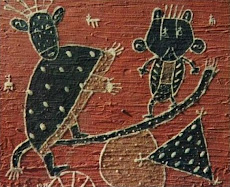
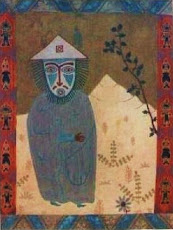
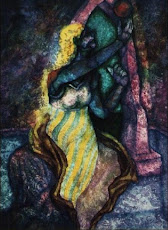
Haikutwotopeh: Old Man of the North
1984
by Eric Whollem
mixed media on paper
Collection of the artist
9" x 6"
copyright by the artist

How the People Were Held Captive by Haikutwotopeh

According to Concow Maidu legend the People were gambled away
to the Old Man of the North who lived near Mt. Shasta. This happened
long, long ago. In traditional gambling among Native Americans any sort of
material goods are placed up in betting. The gambling away of one's own
relatives is another matter. . . The story of how the People were reclaimed
is related below. . .

Gambling among the Maidu is referred to as the Grass Game. It is played by
two teams who oppose each other, each first putting forth bets. Two bones
are held in a peron's hands. One bone has a black stripe down the middle to
differentiate it from the other bone. The singers on the opposite team sing
their gambling songs, meanwhile trying to guess which bone is in which hand
of the person concealing them.

A culture hero, Oankoitupeh, gambled with Haikutwotopeh, the Old Man
of the North, and won the People back. After this betting on one's relatives
was forbidden among the Maidu. It had caused extreme grief to the People
to have lost relatives in gaming.
  
Today the People live in Butte County, California, hundreds of miles to the
south of Shasta. But many of their old legends concern places like Weludih
near the Trinity River. The Cato Indians of the Coast Range are cousins of
the Maidu and share common cultural elements, such as the story of Woctolly,
the salmon merman. The Cato use the same phrase of greeting as the Concow:
'hey-ta-nanni.'

The triangular forms in the above drawing represent the Mt. Shasta area, or
the Trinity Alps. My painting is done in a pictographic style, based on my
studies of the Rock Art of early California. The Maidu are known to have
left a number of engravings in stone, but they never seem to have practiced
the art of painting on stone as done by Indians like the Modoc and the
Chumash.

Gambling is considered sacred today, largely because Oankoitupeh won the
People back in his contest with Haikutwotopeh. The Grass Game brings the
People together. It is 'just a game' according to Martin of Berry Creek,
California. But it is a symbol of unity.

_______________

See my gallery of Abstract Art on this link:

Readers interested in my posts on the Maidu should view:

Those interesest in my posts of Maidu Faux Postage Stamps can find them here:

*

MYTHOGRAPHIC ART
Abstract art.
Maidu Indians.
MYTHOLOGY.
Mixed media painting.
Pictographs and petroglyphs.
FIGURATIVE ABSTRACTION
Abstract figure painting
Contemporary painting

*

Monday, September 20, 2010

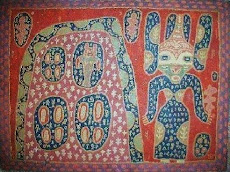
NETDIMKODOM: THE LAND OF DREAMS/ Concow Maidu Indian Culture/ Hiki the Snake/ Nem Yani/ The Yeponi/ Mt. Konocti/ MYTHOGRAPHIC ART by Eric Whollem/ EARTH PIGMENTS AND AQUEOUS MEDIA on paper/ A PICTOGRAPHIC ABSTRACTION that interprets the rock art of prehistoric California in light of modern art


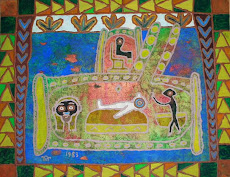
Netdimkodom: The Land of Dreams
1992
by Eric Whollem
earth pigments, India ink, acrylic emulsion,
& plastic emulsion on paper
9" x 6"
copyright by the artist

A Shaman in the World of Dreams
NETDIMKODOM: THE LAND OF DREAMS

I lived off and on for thirty-five years on Maidu Indian family land in
Feather Falls, California.  I was privileged to have known Bob Jackson,
the Maidu patriarch. He was born in a rustic Indian village on what is
now the hiking trail in to Feather Falls. Bob Jack, as he was called by
family and friends, believed that the world is flat to his dying day,
having been raised in the old ways, & having heard all the old stories as
a child.

My friend Robert and I would drive Bob Jack to town once a week to get
supplies. Bob Jack was a jolly fellow with a large collection of old Jazz,
Western Swing and Blues 78's. He kept an old  Victrola to play them. He
would sit for hours out under the old walnut tree to commune with friends
and neighbors who would come to visit.


A STORY OF THE SNAKE CAVES

I have met a number of shamans of the Concow Maidu. The head
shaman of the Maidu is called 'Yeponi.'  One day I picked up an old
white-bearded drunk along the road going up to the Feather Falls
general store. He was hitchhiking.

He was dressed in a plaid shirt and overhauls. He told me: "I am a
doctor; respect that." As the store was closed I offered to give him
a beer down at the house. He related to me much about the world of
dreams. He told me also about the sacred hot springs of Nem Yani,
which connect by a cave system that crosses the Sacramento Valley
and comes up at Clear Lake. He said this cave is guarded by snakes.

Nem Yani is the local name for Stringtown Mountain, so named
because in the old days there was a Maidu settlement there which was
composed of a long line of Indian houses in a row. 'Nem Yani' means
'Big Mountain.'

Interestingly enough, a few weeks later I happened to travel to Clear
Lake, and walking on the shore of the lake, I met a man with a metal
detector. He pulled up a heavy Spanish gold image of Christ right at
my feet.  It must have weighed three pounds. He said he was there
with a group of adventurers who were going over to explore the caves
at Mt. Konocti the next day; he said I could come with him. I asked
him if the cave was filled with snakes. He said, "Yes."

Konocti is an old volcano, actually not that old, as it was created about
10,000 years ago; and is legendary in the tribal history of the Pomo
Indians, as it is said to be made of the bodies of two lovers. The Pomo
story of today contains reminiscences of geological events thousands
of years ago.

As a man in a camp on the shore of the lake had just killed a huge
rattlesnake that had come into camp; and then gotten into a terrible
fight with his wife, I remembered what the shaman had told me about
the guardian snakes. I felt this cave was guarded by snakes wanted
curious humans to keep at a distance. So I never went with the adventurers
to see the cave on Konocti. But the gold image of Christ found in the sand 
seemed to be a symbol of the truth in all that was happening and told to
me.

The Maidu believe the Sacramento Valley was created by a great snake
named Hiki, a creator spirit. Are the tunnels that cross the valley still
protected by Hiki? Cowboys that live in the Willows area, not far from
the Sutter Buttes have stories, I hear, about caves that connect the
Buttes with the Clear Lake area. Some things are better left to the
realm of mystery.

I used to have powerful dreams living in Feather Falls. Often I would
go to Indian dances in my dreams. There used to be a big ceremonial
lodge on the grounds where I lived.


KUKSU DREAM RELIGION

The religion of the Maidu is called Kuksu. It is based on dream
wisdom. See my links below to read more about the Kuksu Dream
Society.

Kuksu is the name of the first man, created by Wonomi, the Earth
Maker. He was born on Table Mountain near Oroville, California.


EXHIBITS

My painting seen here incorporates images based on the Rock Art
of early California. Some of the paint used in this work is earth
paint that I prepared from rough natural earth pigments.

'Netdim' means dreams in Concow Maidu dialect. 'Kodom' means
'country.' Hence the title of the painting on this post, 'Netdimkodom.'

Some of my pictographic abstractions have been exhibited at
the Crocker Art Museum in Sacramento, California. And also
I have shown my works at the Society for California Archaeology.

The Lowie Anthropology Museum in Berkeley, California, houses
a collection of my earth paintings, many of which relate to
the lore of the Native Americans of California.

I have also been a frequent exhibitor at the Mendocino Art Center
on the Northern California coast--from the early 1990's up til 2007.

_______________

Readers interested in my posts on Shamanism should see this link:

My gallery of Abstract Art can be found here:

See my posts about the Kuksu DREAM RELIGION here:


*

MYTHOGRAPHIC ART
Earth paints.
Mixed media.
Pictographic abstraction.
Maidu Indians.
Shamanism.
FIGURATIVE ABSTRACTION

*

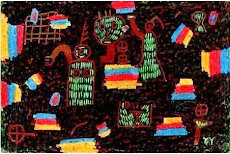
POW WOW/ A Pictographic Abstraction Based on Studies of Native American Rock Art/ A mixed media painting on paper by Eric Whollem


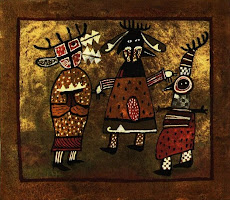
Pow Wow
1984
by Eric Whollem
mixed media on paper
copyright by the artist

The Big Time

Among the Concow Maidu Indians of Northern California, the
Pow Wow is generally referred to as a 'Big Time.'  I lived off and
on for quite a few years in the Feather Falls area of the north
state. My neighbors were mostly Maidu. Often Ralph Martin, one
of the last native speakers on the ridge, would stay at Frank Jones'
place next door down the road.

I have exhibited my work at a few Pow Wows over the years. Pacific
Western Traders in Folsom, California, invited me to one of their
Native American pow wows back in the 1980's. I remember especially
having some good talks with Stan Padilla, a Yaqui Indian artist who
now lives in the Auburn area. He enjoyed seeing my use of earth
pigments made into paints. Later I saw him exhibiting in the book
room at the Society for California Archaeology. Marija Gimbutas,
the well known feminist anthropologist, was there with us.

I had a workshop at a Pow Wow in the Municipal Auditorium in
Oroville, California, some time ago. I had a workshop on making
paints from earth. There I met Granny Lou Salzarulo, who was
a good friend of Bryan Beavers, now well known as a historian
of the Maidu.

______________

Readers interested in my art that is based  NATIVE AMERICAN Pictographs should see:

View my gallery of Abstract Art on this link:


*

ABSTRACT ART.
Pictographs.

*

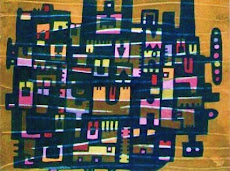
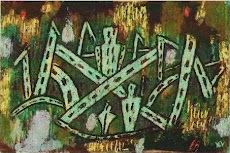
KAKINIM/ Art based on California Indian Rock Art/ Concow Maidu language/ A GEOMETRIC PICTOGRAPHIC ABSTRACTION


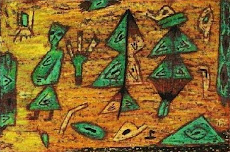
Kakinim
1985
by Eric Whollem
mixed media on paper
9" x 6"
copyright by the artist

Pictographic Abstractions Based on Native American Rock Art

This mixed media work is entitled using a word from the Concow
Maidu language. 'Kakini' means 'spirit.' 'Kakinim' is the plural form.

______________

See my works that are based on studies of preshistoric Rock Art on this link:

BELOW IS A VIDEO
THAT FEATURES
PICTOGRAPHIC PAINTINGS

ERIC WHOLLEM                              


My gallery of Abstractions both figurative and geometric can be found here:


FIGURATIVE EXPRESSIONISM                   


Those interested in my interactions with the Maidu may want to see:


CONCOW MAIDU LORE IN THE PAINTINGS OF         
ERIC WHOLLEM                                 


*

ABSTRACT ART
Mixed media painting.
Maidu Indians.
Pictographs.

*

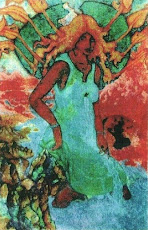
NEM OOST KOLLEM/ Goddess concepts in the lore of the Concow and Mountain Maidu Indians of Butte and Plumas, Counties, California/ Art by Eric Whollem/ PICTOGRAPHIC ABSTRACTION/ Mythographic Art


Nem Oost Kollem
1984
by Eric Whollem
mixed media on paper
detail from 'Birth of the Eyes of Space'
Copyright by the artist

CLICK ON IMAGE TO ENLARGE

A Goddess With Child
CONCOW MAIDU CONCEPTS IN THE ART OF ERIC WHOLLEM

This image is a detail from a larger work, entitled 'Birth of the Eyes
of Space,' a mixed media work on paper.

The title is derived from the Concow Maidu language. 'Nem' means
'big.'  'Oost' means 'belly.' And 'kollem' is 'woman.'

There is a large granite dome in Butte County, California, named by
the Concow Maidu: 'Oost Ho,' or 'Belly Rock.' It is a symbol of a
great Goddess in pregnancy. Traditionally the rock symbolizes both
birth and death, as the Maidu used to roll the bodies of the deceased
in baskets off this high granite dome that overlooks the Middle Fork
of the Feather River. This river is called Supi Poboku in the local
dialect.

The Concow Maidu have legends of the Great Women Spirits who
were creatrixes in the beginnings. Up on Indian Creek that flows
from Indian Valley in Plumas County there is a rock outcrop that
represents the menses of one of these Goddesses. This site is sacred
especially to the Mountain Maidu.

Some tribal leaders of the Maidu are women. Although the Kuksu
Secret Society was originally for men only, very frequently we find
women in the role of tribal leaders today.

_______________

Readers interested in my posts on the Maidu may want to view:

Much of my Goddess imagery is found in my Ceramic Sculpture. 'Nem Oost Kollem' is a work that was created shortly before I began my serious clay work in 1988. Through much of the 1990's my art was increasingly three dimensional. See my Goddess Art on this link:

*

MYTHOGRAPHIC ART
Mixed media painting.
Abstract art.
Goddess.
Pictographic abstraction.
Mythology.
Maidu Indians.

*

*

SUMI MAIDEM/ A pictographic image of Deer Man/ Concow Maidu Language/ MYTHOGRAPHIC ART/ Mixed media art by Eric Whollem/ EARTH PIGMENTS & gouache on paper


Sumi Maidem
1977
by Eric Whollem
gouache and earth pigments in casein on paper
7" x 9.75"
Collection of the artist
Copyright by the artist

CLICK ON IMAGE TO ENLARGE

Deer Man

This painting incorporates earth pigments gathered in nature with
gouache paint. The title, 'Sumi Maidem,' translates into 'Deer Man.'
I utilized expressions from the Concow Maidu Indian language.
Sumi means friend in Maidu. This image is of a benign shaman.

_____________

Readers interested in my posts of Abstract Art should view this link:

CLICK ON IMAGE TO ENLARGE

EARTH MOTHER
earth pigments on panel
by Eric Whollem


Those interested in my approaches to Pictographs and Petroglyphs should see:

BELOW IS A VIDEO
DEALING WITH
PICTOGRAPHIC ART

ERIC WHOLLEM                                


My posts on Shamanism can be found here:

Those interested in the Concow Maidu should view my posts:

BELOW IS A VIDEO
THAT TALKS ABOUT
CONCOW MAIDU INDIAN RELIGION

ERIC WHOLLEM                                

*

MYTHOGRAPHIC ART
Mixed media painting.
Maidu Indians.
Abstract art.
Pictographs and petroglyphs.
FIGURATIVE ABSTRACTION

*


Sunday, September 19, 2010

PE-UCH-ANO/ A Concow Maidu Legend/ Notes on the Maidu Cultural Heritage/ A mixed media painting by Eric Whollem/ MYTHOGRAPHIC ART/ Native American Folklore from Butte County, California


Pe-uch-ano
1994
by Eric Whollem
mixed media on paper
Private collection
copyright by the artist

CLICK ON IMAGE TO ENLARGE

The Story of Pe-uch-ano

The Konkow Valley Band of Maidu website has an old Maidu legend
which I once read in another version in Stephen Power's book, 'The Tribes
of California.'  I refer to the story of Pe-uch-ano (also spelled Puchano or
Piuchinnuh).  See the Maidu.com link below for the complete story. This
apparently is a story that was transcribed at the Round Valley Reservation
in the 19th century.

Concow is varyingly spelled 'Konkow.'  Concow literally translates as
'Beautiful Parklands.' The Concow Maidu Indians are the Native American
inhabitants of Butte County, California.

Saturday, September 18, 2010

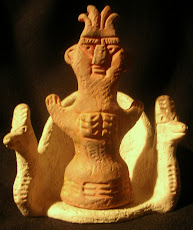
CERAMIC GODDESS SCULPTURE/ Clay Art by Eric Whollem/ MYTHOGRAPHIC ART/ Natural earth pigments and oxides on white earthenware clay & flax cord with ceramic beads by the artist


Red Figure With Beaded Headdress
2007
by Eric Whollem
Red earth pigment, oxides, & flax cord;
white earthenware clay
Photo copyright by the artist

CLICK ON IMAGE TO ENLARGE

To view my posts on Ceramic Sculpture view this link:

Readers interested in my approaches to Natural Earth Pigments should see these posts:

My posts on the topic of Goddess Art can be found here:

*

MYTHOGRAPHIC ART
Goddess Art.

*

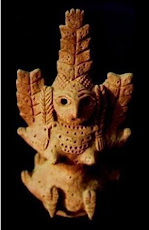
FIGURATIVE CERAMIC SCULPTURE/ Clay Art by Eric Whollem/ 'Devotional Figure in a Shrine'/ Copper carbonate, oxides and found earth on white earthenware clay


Devotional Figure in a Shrine
2007
by Eric Whollem
copper caronate, oxides and found earth
on white earthenware clay
Photo copyright by the artist

CLICK ON IMAGE TO ENLARGE

See my complete list of posts on Ceramic Sculpture on this link:

*
MYTHOGRAPHIC ART
 Metaphysical art, spirituality.
*

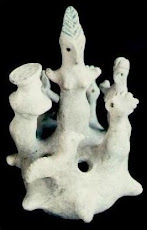
CERAMIC GODDESS SCULPTURE/ Clay Art by Eric Whollem/ 'Seated Goddess in a Triangular Shrine'/ MYTHOGRAPHIC SCULPTURE/ Oxides on white earthenware clay


Seated Goddess in a Triangular Shrine
2007
by Eric Whollem
oxides on white earthenware clay
Photo copyright by the artist

CLICK ON IMAGE TO ENLARGE

See my posts of Ceramic Sculpture on this link:


Ceramic Sculpture Video.                                      

Readers interested in my art that deals with the Goddess concept should view:

*

MYTHOGRAPHIC ART
Metaphysical art, spirituality, the Goddess.

*

Friday, September 17, 2010

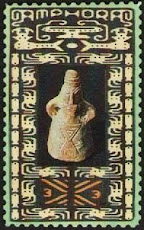
Concow Maidu Culture/ OOTI the acorn/ 'EARLY SPANISH CONTACTS WITH THE MAIDU' and 'A BRIEF HISTORY OF OROVILLE'/ Faux postage stamps/ ARTIST STAMPS by Eric Whollem/ Mooretown Provisional Postage from MAIDEM KODOM


Ooti
Maidem Kodom
2010
by Eric Whollem
copyright by the artist


Ooti the Acorn

Ooti is the name given to the staple food of the Maidu, the acorn.
Acorns were made into soup or bread. Sometimes meat or other
seasonings were added.

Manzanita berries also were used to make a sweet bread.

When food supplies got low, the toxic seeds of the buckeye
were carefully leeched to make food.

The Maidu used bedrock mortars and large smooth grinding
stones to grind the acorns, which were then leeched with water
in special baskets.


       CONCOW MAIDU LORE IN THE ART OF ERIC WHOLLEM


EARLY SPANISH CONTACTS WITH THE MAIDU

Today at Powwows or Big Times fry bread has been added to the
Maidu cuisine. This may or may not be an influence that arose
from early Spanish contacts in California. A number of words in
the Concow dialect are Spanish in origin--such as 'pane' for
bread, 'caballo' for horse, and 'pantalon' for pants.

A friend of mine once found a rusted out old Spanish sword on
the shores of Lake Oroville. There are few physical remains of
Spanish colonization in Butte County, as the Spanish usually
preferred lands on the coast.

Concow Maidu Culture/ Indian Reservation Stamps: 'NATIVE AMERICAN TRIBAL STAMPS AND THE FAUX POSTAGE OF MAIDEM KODOM'/ OOTI the acorn/ Artist stamps by E.Whollem/ Cyberstamps based on an ancient California culture


Ooti
Maidem Kodom
2010
by Eric Whollem
copyright by the artist


Native American Tribal Stamps and the Faux Postage of Maidem Kodom

There is a genre of stamps called variously 'Indian Reservation Stamps'
or 'Native American Tribal Stamps.'  The stamps that I have created for
Maidem Kodom, my own fanciful 'Maidu Nation' are not of these
categories, as they are 'faux postage stamps,' or 'phantom cinderellas'
as they might be called by collectors. They are my own artistic creations
and not authorized by any Native American group.

The first Native American group to issue stamps of their own was the
Rosebud Reservation of the Sioux in the 1950's. The Crow Creek
Sioux issued the first pictorial reservation Hunting Stamp in 1989.
See the link below to view these authentic Indian stamps.

Thus far most Native American stamps have either been Hunting
Permit Stamps or Tobacco Tax stamps.

Michael Jaffe wrote an article in which he gives a historical account
of Indian Reservation Stamps. In 1992, Jaffe writes, the Pine Ridge
Reservation of the Oglala Sioux issued some wildlife stamps that
were intended mostly for sale to collectors. This was followed by a
similar issue by the Sisseton Wapeton Sioux Tribe, who similarly
decided to create stamps for philatelic purposes. Most Native
American tribal stamps have been very limited editions of stamps
printed just for hunting and fishing permits.


CONCOW MAIDU FAUX POSTAGE STAMPS

Fantasy stamps have been created by artists for hundreds of years.
The first such stamp was created as a parody of the British Colonial
Tax stamps which aggravated the American Colonists. Subsequently in
1862 George Hussey designed a fantasy local courier post called
the Winan City Post, which caused a sensation among inventive stamp
designers in the 19th century. Copies and varieties of this stamp were
created until the year 1878. 

Since then thousands of faux postage stamps have been designed
by artists. Names for this kind of stamp include: phantoms, artist stamps,
artistamps, cinderella stamps, fantasy stamps, postoids,  
and micronational stamps.

'Maidem Kodom' means 'Land of the People.' It is the name of my
own postal micronation and is not authorized by any tribal
authority.


Ooti
Maidem Kodom
2010
by Eric Whollem
copyright by the artist

CLICK ON IMAGE TO ENLARGE


The 'Mooretown Post Office' and the 'Mooretown Provisional Post' are
artistic liberties I have taken with the creation of these stamps which
are designed with the intention of celebrating Maidu cultural ideas
as they relate to the art that I have created over the years, having
lived, off and on, at Black Earth Village in Feather Falls, California
for about thirty-five years.

The old name for Feather Falls is Mooretown.

*
The art on this stamp is made from earth colors that I gathered myself;
it is a detail of my painting entitled, 'King of the Wood.'

___________

Those interested in depictions of Native American Reservation Stamps should view this link:

Readers interested in Michael Jaffe's article on RESERVATION STAMPS should check this out:

For my own blog post about Native American Tribal Stamps see:

For an account of Faux Postage Stamps see Wikipedia:

For a look at my own  Artist Stamp creations see:

For those interested in Duck Stamps and other Hunting Permit Stamps see this list of links, which is put online by the National Duck Stamp Collectors Society:

Readers interested in Micronation Stamps might want to read:

For my complete gallery of Maidu Indian Faux Postage Stamps see:

*

ARTIST STAMPS
Artistamps, faux postage,
cyberstamps, mail art, micronation stamps,
cinderella stamps,
digital art,
fantasy stamps.

*

Concow Maidu Culture/ OOTI the acorn/ ARTIST POSTER STAMPS by Eric Whollem/ Faux postage from the micronation of Maidem Kodom/ A cinderella CYBERSTAMP from the MOORETOWN POST OFFICE


Ooti
Maidem Kodom
2010
by Eric Whollem
copyright by the artist

One Feather Postage From the Country of the People

Maidem Kodom is my name for the 'postal system' that has issued
these faux postage stamps. Maidem Kodom means 'Country of the
People.'  This postal system is, of course, an extenstion of my artistic
imagination and has no real connection to any tribal authority.

Poster stamps are stamps that are an advertisement for something.
These stamps are, of course, a promotion for my art. . . relating to
the public my interest in and interactions with the Concow Maidu
Indians of Mooretown Ridge in the Feather Falls area of Butte County,
California.

Poster stamps began as a genre of stamps in the late 19th century and
were popular up until the 1940's. Stamp collectors categorize them as
a subvariety of 'cinderella stamps.'

_____________

Readers interested in my articles on Poster Stamps should check out this link:

My posts on the Maidu can be found here:

My general posts on Artistamps may be found on this link:

*
Artist stamps, artistamps, cinderella stamps, cyberstamps, fantasy stamps, faux postage, mail art, micronation stamps, poster stamps.